
Generative Engine Optimization (GEO) for Shopify: The 2026 Playbook
GEO — Generative Engine Optimization — gets your Shopify store cited by ChatGPT, Gemini and Perplexity the way SEO ranks you on Google. The four levers, and which categories are winnable.
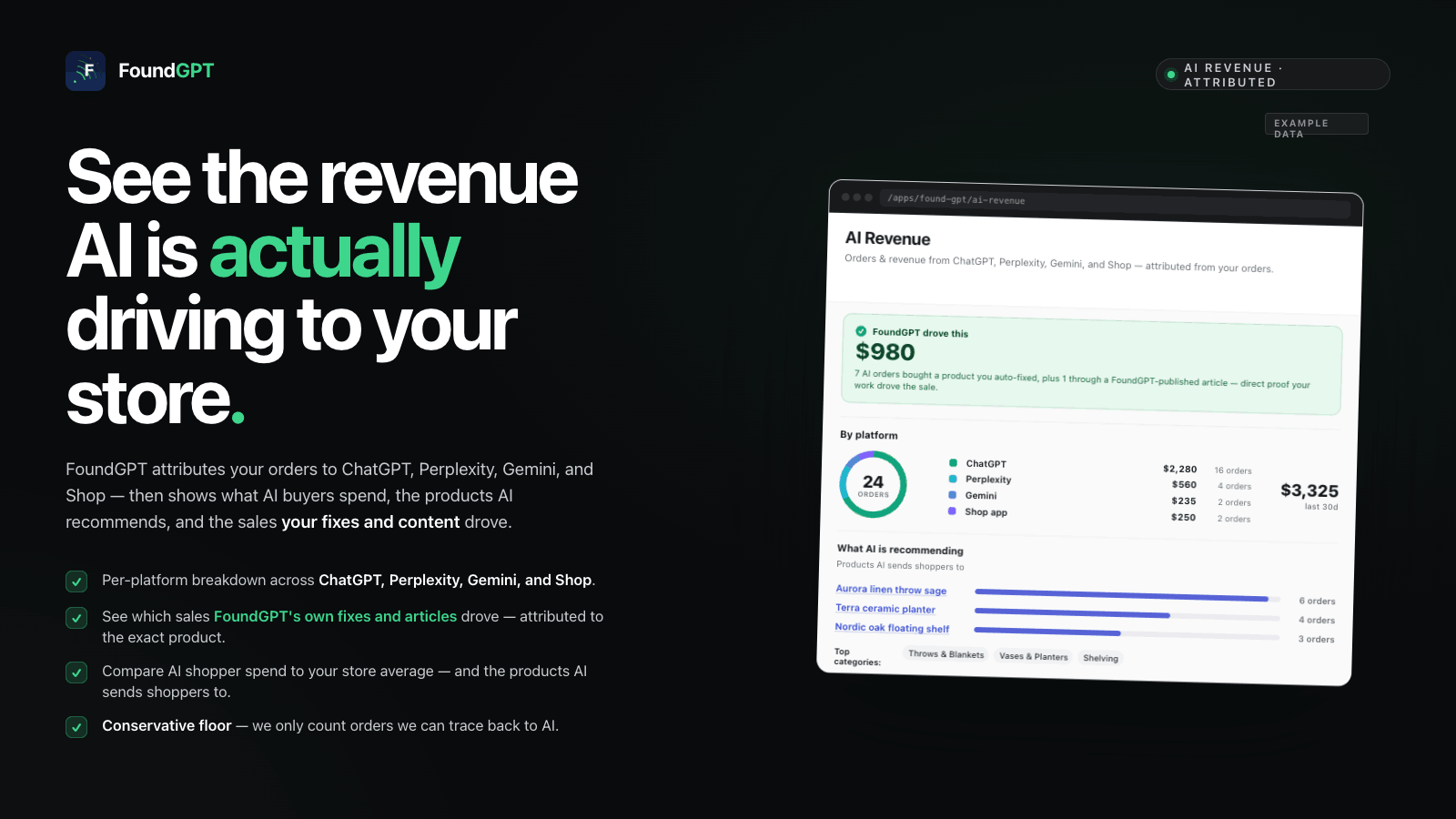
Short answer: Generative Engine Optimization (GEO) is the practice of getting your store cited and recommended by generative AI engines — ChatGPT, Gemini, Google AI Mode, Perplexity — the way SEO gets you ranked on Google. For a Shopify store it comes down to four things: making your product data machine-readable, keeping AI crawlers unblocked, publishing the specific content buyers ask about, and tracking whether the mentions actually happen. This is the 2026 playbook, grounded in what we've measured across 111 stores.
→ Check your store's GEO readiness free
What GEO is (and isn't)
GEO optimizes for inclusion in a generated answer, not for a rank on a list of links. When a shopper asks an AI assistant "what should I buy," the engine writes one answer and cites a handful of sources. You're either in that answer or you're invisible — there's no "page two."
It is not a rebrand of SEO. The two overlap on fundamentals (clean structure, good content, fast pages) but diverge on what wins:
- SEO rewards rankings, backlinks and keyword coverage.
- GEO rewards extractability (can the engine pull a specific fact?) and citation-worthiness (is your page the best source for this exact question?).
You can rank #1 on Google and still be absent from AI answers — we've measured stores in exactly that position, including some excluded from Google's own AI Overview while ranking first organically. See AI search vs traditional SEO.
The four levers of GEO for Shopify
1. Make your product data machine-readable. AI agents answer from schema.org structured data, not your theme's visual layout. Price, availability, material, dimensions, variant options — if they live only in images, tabs or prose, an engine can't reliably use them. This is the single highest-return lever, and it's the one you fully control. Scan what AI can currently read →
2. Keep AI crawlers unblocked. A permissive robots.txt and a permissive edge/firewall are not the same thing — plenty of stores technically allow GPTBot in robots.txt while a bot rule quietly returns a challenge. Confirm the major AI user-agents (GPTBot, Google-Extended, PerplexityBot, ClaudeBot, OAI-SearchBot) can actually reach your pages. And publish an llms.txt — a clean catalogue map at your domain root.
3. Publish the specific fact buyers ask about. Across four unrelated verticals we tested, the pattern held: specification and specific-intent questions are winnable; taste and "best brand" questions go to publishers and marketplaces. A store won "best wall art for anxiety relief"; a handloom store won a "jamdani weave" query — because each published the exact fact the question turned on. Generic "best X" content competes with Vogue and loses. Write the technical explanation nobody else in your niche writes.
4. Track whether the mentions happen. GEO without measurement is guessing. Run your real buyer queries across the engines, record who's cited, and re-check over time — roughly half of citations drift month to month in our tracking. See how to check if ChatGPT recommends your store.
Where independent stores actually win
The uncomfortable truth from our data: whether GEO is winnable depends on your category, not your effort.
- In gemstones, stores were cited in 8 of 8 queries — no editorial gatekeeper. Highly winnable.
- In supplements and skincare, publishers (Healthline, editorial, clinics) owned nearly every answer. Here GEO on your product pages barely moves the needle; the route in is editorial coverage and community presence.
So step one of any GEO plan is to find out which kind of category you're in — run the queries and see whether AI cites stores or publishers. Pick the wrong playbook and you waste months. See how to get recommended by ChatGPT.
A GEO checklist for Shopify
- Run a readiness scan and fix every failing structured-data factor. Start here →
- Publish
llms.txtand keep it current as your catalogue changes. - Verify AI-crawler access in robots.txt and your edge config.
- Structure specs as data — material, dimensions, GSM, certifications — not images or tabs.
- Write specific-intent content — the exact buyer question you can answer best.
- Test your category to know whether stores or publishers win it.
- Track mentions monthly across ChatGPT, Gemini, Google AI Mode and Perplexity.
FAQ
Is GEO different from SEO?
Yes. SEO optimizes for rankings on a list of links; GEO optimizes for inclusion in a single AI-generated answer. The fundamentals overlap, but GEO adds extractability (structured data) and citation-worthiness as first-class factors.
Is GEO worth it if I already do SEO?
It's additive, not a replacement — AI search is a new surface with different rules. And it's early: brands that get readable and cited now gain a durable head start in a channel most competitors haven't touched.
What's the fastest GEO win for a Shopify store?
Structured product data. Move the specs buyers ask about out of images and prose into machine-readable fields — it's the highest-return, fully-controllable lever. Scan yours free.
Does GEO guarantee ChatGPT will recommend me?
No. It makes you readable and eligible; being recommended also depends on category and authority. In publisher-dominated categories, product-page GEO alone won't put you in the answer.
Method and data
Testing: real buyer queries across ChatGPT, Gemini (2.5 Flash with grounding), Google AI Mode and Perplexity; every cited domain recorded and classified. Figures: cumulative across 111 Shopify stores since launch — 23,728 AI-search checks, ~99,000 structured-data fixes, 2,022 mentions tracked. Known limitations: many category findings rest on small per-query samples and single runs; treat them as directional and category-specific, not universal laws.
About the author
Rahul — Founder, FoundGPT
Rahul built FoundGPT and personally ran the multi-engine visibility tests behind this page. Across 111 Shopify stores he has run 23,000+ real AI-search checks on ChatGPT, Gemini, Google AI Mode and Perplexity, and applied ~99,000 structured-data fixes.