
Shopify's GEO Playbook, Translated for Stores Without an Enterprise Team
Shopify's GEO playbook is written for enterprises with CTOs. Here's the same three-pillar playbook as one-click SMB actions — plus the content layer their version leaves out entirely. Backed by 207k citations.
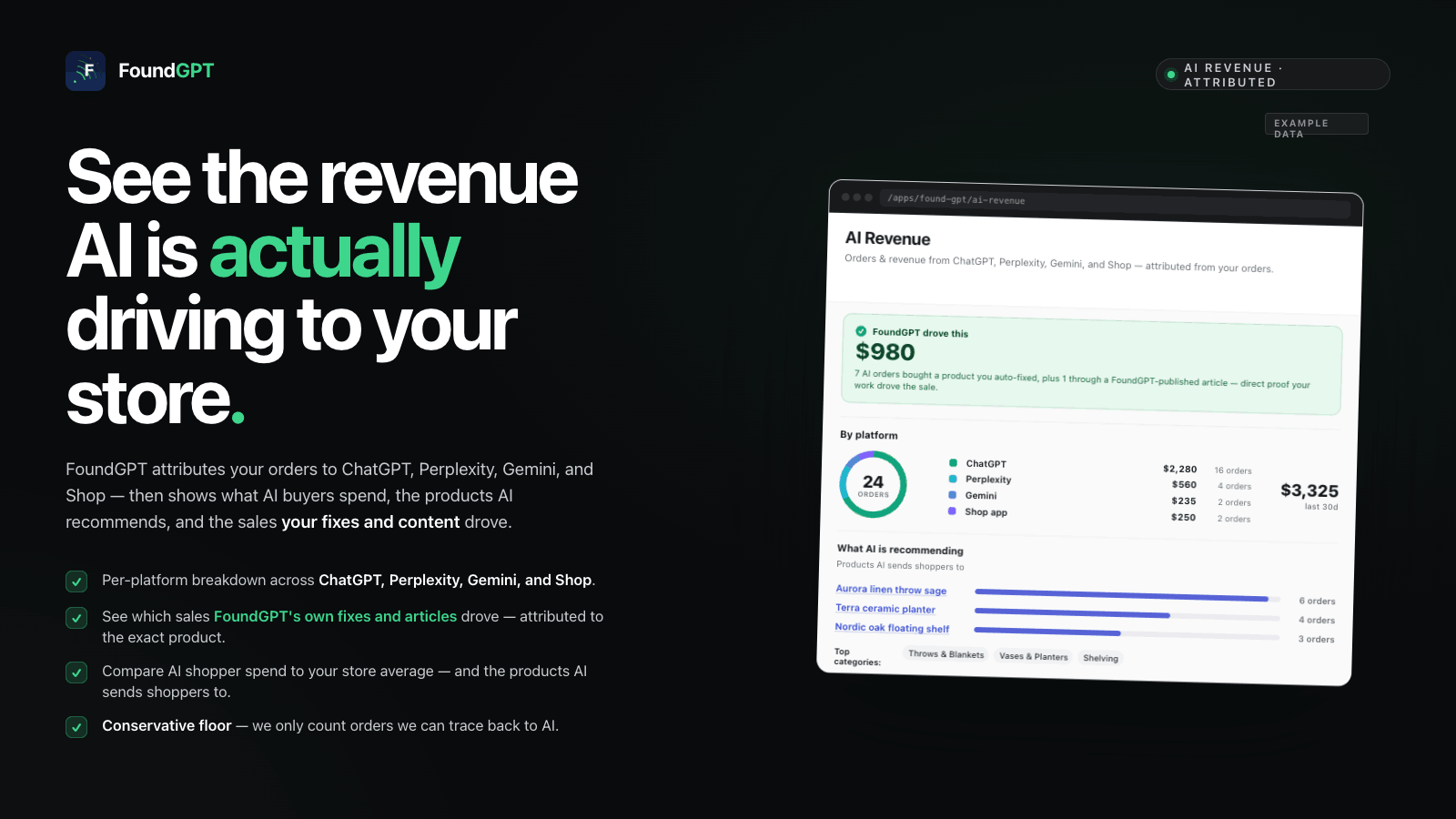
Shopify just told the world AI search is exploding — orders up 13× year-over-year, AI shoppers converting 50% better. Their playbook is written for enterprises with CTOs. Here's the same playbook as one-click actions — plus the layer their version leaves out entirely.
In the past six months Shopify has published three major pieces on AI search: a GEO Playbook, a technical guide to agentic-ready product data, and fresh commerce data showing how AI shoppers behave. If you read nothing else, read their numbers:
- AI-referred orders grew ~13× year-over-year (Q1 2026); sessions grew 8×
- AI-referred shoppers convert ~50% better than organic search, with 14% higher order values
- In research-heavy categories the gap doubles: watches convert 2.4× better, necklaces 2.3×
- Over half of AI shoppers land directly on a product page — they arrive ready to buy
- When AI drew on clean, structured product data, shoppers converted 2× better than from scraped data
- Gartner predicts 20% of transactions will run through AI platforms by 2030
We run visibility tracking and AI-shopper analytics for a fleet of independent Shopify stores, and our data agrees with theirs: the AI-referred sessions we record land overwhelmingly on product pages, and our fastest-growing store is — no coincidence — a jewelry store, the exact category Shopify measured at 2.3×.
So the trend is real and mutually confirmed. The question is what a store without an enterprise data team actually does about it. Shopify's playbook has three pillars. Here's each one, translated from enterprise-speak into actions that take minutes.
Pillar 1: SEO fundamentals — your product data IS your SEO
Shopify's advice: quality content, correct title tags, an unblocked robots.txt, a complete sitemap. Their reasoning is worth understanding: when you ask an AI "best marathon shoe for flat feet under $150," the agent secretly runs multiple search queries ("query fan-out") and synthesizes what the search index returns. AI answers are built from search results — so what ranks, gets recommended.
The SMB translation: your product titles, descriptions, and meta descriptions are the raw material. Shopify's own guide warns against titles like "Ocean Breeze" when the product is a texturizing sea salt spray — AI takes words literally. Audit for: marketing-copy titles, thin descriptions, missing meta descriptions, missing alt text. (This audit is exactly what our free scanner does in sixty seconds, across your whole catalog.)
Pillar 2: Brand building — teach AI who you are
Shopify's advice: authority, reputation, reviews, PR. Their killer diagnostic — one we've automated — is beautifully simple: ask ChatGPT "What is [your brand]?" If AI describes a different company, or draws a blank, you have a brand-recognition gap that blocks every "best X brand" query you could otherwise win. (Here's how to check what ChatGPT says about your store.)
The SMB translation, in order of effort:
- One sentence on your About page: "[Brand] is a [what you sell] brand based in [where]." That single line is training data.
- Publish an identity page titled "What is [Brand]?" — literally answering the question AI gets asked.
- Organization schema (founder, location, founded year) so crawlers index you as a distinct entity.
- Claim your Google Business Profile and social handles — these are the signals AI uses to tell brands apart.
Pillar 3: Data quality — the pipe and what's in it
This is where Shopify's enterprise framing matters most. Their announcement: Shopify Catalog and Agentic Storefronts now syndicate your product data directly to ChatGPT, Copilot, Google AI Mode, and Gemini — a direct API that AI platforms prefer over scraping your site. For most Shopify stores this is being enabled automatically. It's genuinely good news: the plumbing of agentic commerce is becoming free.
But read their guide closely and you'll find the caveat that matters: the pipe syndicates whatever is in your fields. Their own checklist — specific taxonomy ("women's waterproof hiking boots," not "footwear"), literal language, complete attributes for "conversational discovery" (audience, use case, compatibility, fit, materials), variants grouped correctly — is all work that remains yours. Syndicating incomplete data just delivers your gaps to more platforms, faster.
The SMB translation: enrichment is the job. Every product needs a real category, honest titles, and the structured attributes shoppers actually ask about. Doing this by hand across 500 products is weeks; this is precisely the work AI can do for you in bulk (it's what our Auto-Fix does — categories, tags, attributes, descriptions, meta — with a preview before anything changes). (The full 12-point version is here.)
The layer the playbook leaves out
Here's what three Shopify articles never mention: content. Remember query fan-out — the agent researching "best X for Y" against search indexes? Product feeds answer the product lookup sub-queries. But the research sub-queries — comparisons, "best for" lists, how-to-choose guides — resolve against the open web: blogs, editorial, reviews. Our citation dataset (207,000+ AI citations tracked across five engines) shows blog articles and buying guides earning thousands of citations for shopping prompts — content, not feeds, decides who gets recommended before anyone looks up a SKU.
The store in our fleet with the most AI traffic didn't get there through feeds. They published buying guides — dozens of them — AI engines started citing a dozen, and ChatGPT now sends them shoppers daily, landing directly on product pages, exactly the high-intent pattern Shopify measured. Feeds made their products purchasable; content made them recommended.
The whole playbook, in one afternoon
- Scan your store (free, 60 seconds): foundgpt.app/scan — covers the Pillar 1 + 3 checklist.
- Fix what it finds in bulk — categories, attributes, titles, descriptions.
- Add the identity line + Organization schema — teach AI who you are.
- Publish comparison and buying-guide content targeting the questions AI already answers with your competitors' names.
- Measure both ends — which engines mention you, and which sessions and orders actually arrive.
Shopify built the checkout for the AI era and is now building the pipes. The recommendation layer — being the store AI chooses — is still won the old-fashioned way: better data, clearer identity, and content that answers real questions. That part doesn't require an enterprise team. It requires starting.
Sources: Shopify Q1/Q2 2026 commerce data (linked above); Gartner, "Optimize Product Data for Agentic Commerce" (2026); FoundGPT citation corpus (207,297 citations, Apr–Aug 2026, 107 stores).
About the author
Rahul — Founder, FoundGPT
Rahul built FoundGPT and ran the citation analysis behind this piece. Across 111 Shopify stores he has run 23,000+ real AI-search checks on ChatGPT, Gemini, Google AI Mode and Perplexity, and applied ~99,000 structured-data fixes.