
How to Measure ChatGPT & AI Traffic on Shopify — The Honest Guide (2026)
The GA4 referrer method for measuring AI traffic, where it silently lies (mobile apps, evaporating UTMs, Google organic-bucketing, Gemini masking), and how to build an honest AI-traffic scoreboard.
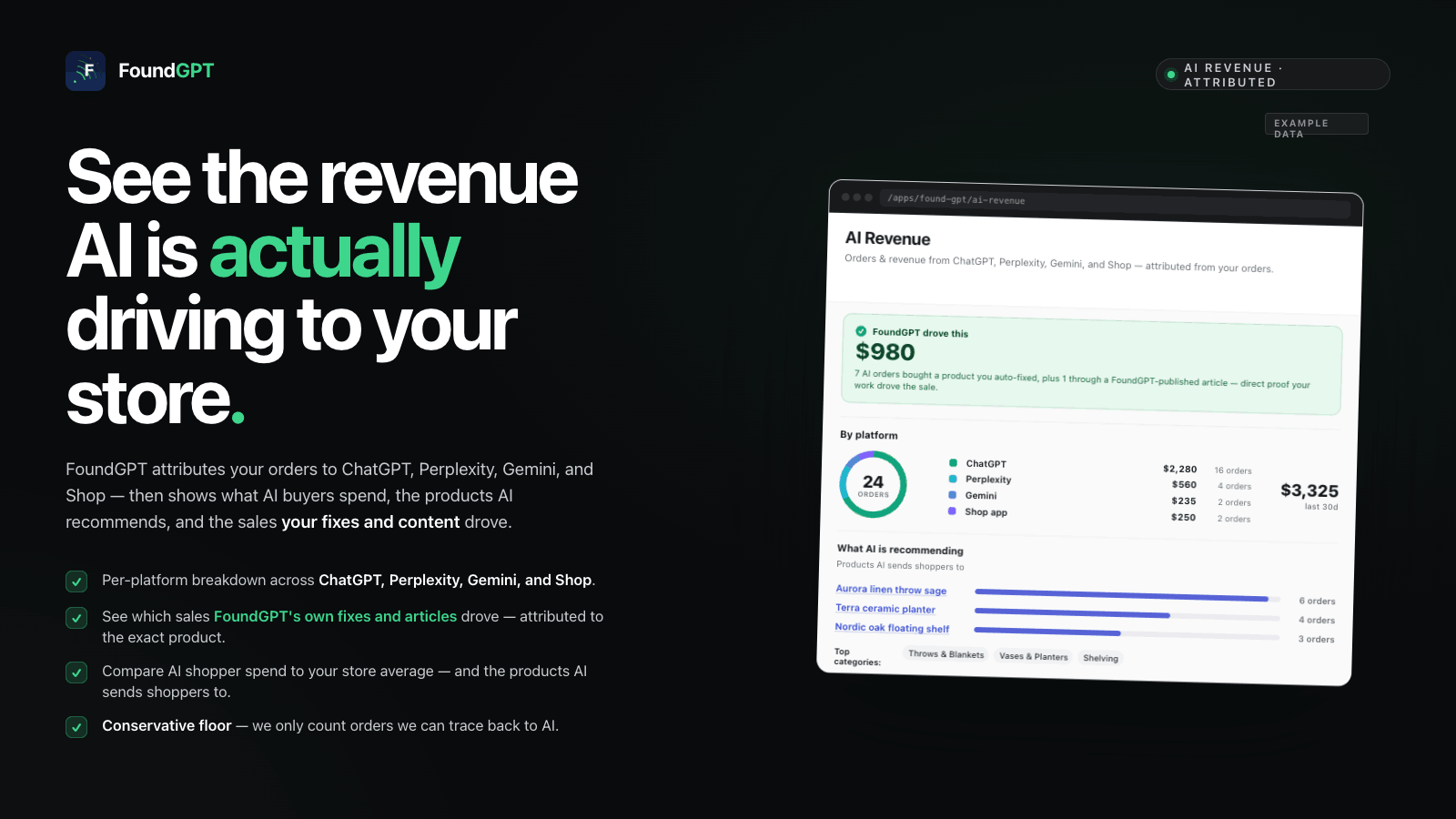
Every AI-traffic guide shows you the same GA4 referrer filter and calls it done. We built an AI-session tracker for Shopify stores, so we know exactly where that method works, where it silently lies, and what it takes to actually see this traffic. Here's the whole picture — including the parts that make your number an undercount no matter what you do.
Shopify's data says AI-referred sessions grew ~3× year-over-year and convert up to 2× better. So naturally you want to know: how much AI traffic does MY store get? Here's the complete answer — the free method, its blind spots, and the fixes.
Level 1: The referrer method (free, 15 minutes)
AI assistants that link out usually send an identifiable referrer or UTM. Build a custom channel group (GA4) or filter (Shopify Analytics → sessions by referrer) matching:
| Engine | What to match |
|---|---|
| ChatGPT | chatgpt.com referrer; links often carry utm_source=chatgpt.com |
| Perplexity | perplexity.ai |
| Gemini | gemini.google.com |
| Copilot | copilot.microsoft.com / bing.com/chat |
| Claude | claude.ai |
In GA4: Admin → Data Settings → Channel Groups → create an "AI" channel with these source conditions. In Shopify Analytics, segment sessions by referrer name. Fifteen minutes, zero cost, directionally useful.
Where the referrer method silently lies
We've watched real AI sessions arrive on real Shopify stores through a first-party pixel. The gaps we've measured or hit ourselves:
1. Mobile apps don't send web referrers. ChatGPT's iOS/Android apps open links with app-scheme referrers (android-app://com.openai.chatgpt) or none at all. Analytics files these under direct. A meaningful slice of AI traffic is mobile — invisible to Level 1.
2. UTMs evaporate. ChatGPT's utm_source=chatgpt.com parameter is real — but redirects and page navigation strip it fast (we've watched it vanish within seconds of landing). If your capture depends on the URL still carrying it at pageview time, you undercount.
3. Google AI traffic reports as "organic." Shopify's own analysts flag this: AI Overviews and much of AI Mode get bucketed into organic search. The fastest-growing Google AI surfaces are structurally invisible to referrer grouping — "your AI number is almost certainly an undercount," in their words.
4. Gemini masks everything. In our 207,403-citation dataset, 99.7% of Gemini's citation links route through a vertexaisearch redirect. What survives to your analytics varies; what you can audit by clicking is nothing.
5. Consent gates the count. Any pixel- or analytics-based method only counts visitors who accepted analytics cookies. In consent-strict regions that's a structural discount on every number. (This one has no fix — only honest labeling.)
Level 2: First-party session tracking (what we built)
Because of gaps 1–4, we built a Shopify web pixel that classifies sessions at arrival — referrer, UTM at first touch (before it's stripped), and app-scheme signals together — and writes each AI session with its source, landing page, and the products viewed in that visit. What that adds over Level 1:
- Landing-page truth: in our data (and Shopify's), AI shoppers land on product pages — 50%+ per Shopify, nearly all sessions in our fleet. Which products AI sends people to is the actionable insight, and referrer reports don't show it.
- Session→order attribution by exact landing path + source — counts, never modeled estimates.
- First-touch UTM capture before the parameter evaporates.
(This ships in FoundGPT on every plan, including free — because we think the measurement layer shouldn't be the paywall.)
Level 3: The two ends referrers can't see
Even perfect session tracking only sees who clicked. The full funnel needs both ends:
- Upstream — are you in the answers at all? Mention/citation tracking against real buyer prompts per engine. This is where Gemini's masking makes mention-tracking (not link-auditing) the only honest instrument.
- Downstream — orders. Shopify's order attribution data (referring source on the order) catches purchases your session pixel missed (different device, cleared consent, delayed purchase). Cross-checking both against each other is how you keep the numbers honest.
The honest scoreboard, assembled
| Question | Instrument |
|---|---|
| Am I in AI answers? | Prompt-level mention tracking (per engine) |
| Which pages earn it? | Citation tracking (unmasked engines) |
| Who's arriving? | First-party session pixel (Level 2) |
| Are they buying? | Order-source attribution, exact-match only |
| What's my floor? | Level 1 GA4 grouping — treat as minimum, never total |
One rule ties it together: treat every AI-traffic number as a floor, not a ceiling. Between mobile referrer loss, Google's organic-bucketing, Gemini's masking, and consent gating, real AI traffic is always higher than measured — which, given Shopify's conversion data on this traffic, is the good kind of measurement error.
See your store's AI visibility and start tracking arrivals — free: foundgpt.app/scan
Sources: FoundGPT session pixel + citation corpus (207,403 citations, five engines, Apr–Aug 2026); Shopify Q1/Q2 2026 commerce data and their published measurement caveats. Blind spots 1–4 measured or directly observed in production.
About the author
Rahul — Founder, FoundGPT
Rahul built FoundGPT and its first-party AI-session pixel. Across 111 Shopify stores he has run 23,000+ real AI-search checks on ChatGPT, Gemini, Google AI Mode and Perplexity, and applied ~99,000 structured-data fixes.